On February 28, 2026, the United States and Israel launched coordinated strikes on Iranian military sites and senior leadership, triggering Iranian retaliatory drone and missile attacks against Israel and multiple Gulf states, plunging the Middle East into its most dangerous military escalation in decades. The strikes, carried out without prior UN Security Council authorization, have raised urgent and unresolved questions about the limits of unilateral military action, the enforceability of international law, and the capacity of multilateral institutions to constrain great power conflict
For UNA Pasadena members, this moment is both a test of the UN system we advocate for and a call to action. The principles enshrined in the UN Charter are not abstract ideals. They are the rules the international community agreed upon precisely to prevent this very situation. Nearly three weeks into the conflict, there remains little clarity as to how and when the violence may be brought to an end, but the UN and its leadership have spoken clearly and consistently. Below, we outline what they have said, and what we can do about it.
What the UN Has Said — Key Official Statements
Secretary-General António Guterres:
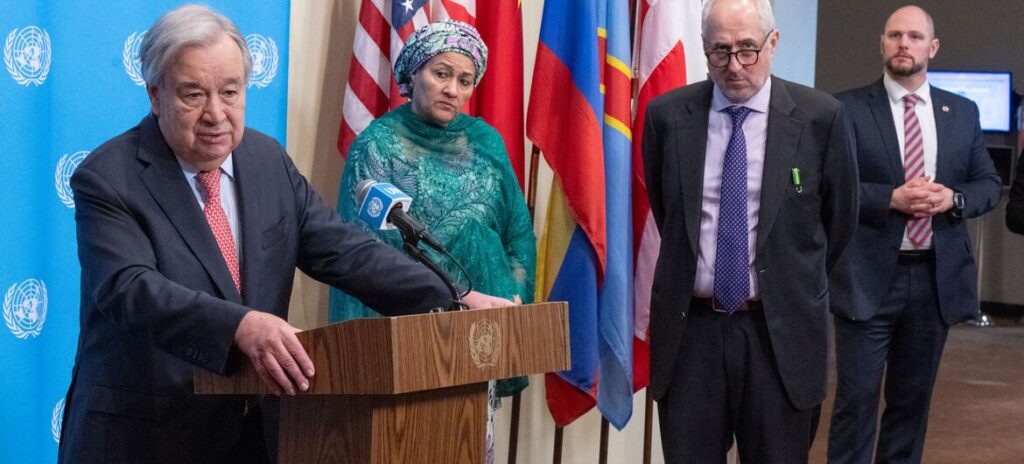
SG Guterres condemned the initial U.S. and Israeli strikes and Iran’s subsequent retaliation, calling both a threat to international peace and security. Guterres has further called for “an immediate cessation of hostilities and de-escalation,” further stating that “there is no viable alternative to the peaceful settlement of international disputes, in full accordance with international law, including the UN Charter,” underscoring the grave threat to international order that these conflicts present.
UN General Assembly President Annalena Baerbock:
Annalena Baerbock, current President of the GA, issued a statement condemning the “extremely dangerous military escalation in the Middle East.” She has further called on the United States, Israel, and Iran to de-escalate, to avoid dragging neighboring countries into the conflict, and to return to diplomacy. Regarding the US-Israeli basis for initiating the attacks, Baerbock noted that Iran’s nuclear program and regional activities must be addressed “in accordance with the UN Charter and international law” (not through airstrikes targeting government and military officials).
UN High Commissioner for Human Rights Volker Türk:
UNHCR Commissioner Volker Türk deplored the strikes and retaliatory attacks, warning that it is the civilians who “always end up paying the ultimate price” and urging leaders to “choose the challenging path of dialogue over the senseless route of destruction.” Türk further raised the alarm about the ongoing threat to nuclear facilities, warning that “all must be done to reduce any nuclear safety risk.”
OHCHR Independent Experts:
On March 11, 2026, a group of UN Special Rapporteurs declared the U.S. and Israeli strikes on Iran and Lebanon “entirely illegal under international law”, warning that the conflict risks setting “a precedent of total impunity for some of the world’s strongest military powers” and calling for an immediate ceasefire and an international peace conference. The UN’s Independent Fact-Finding Mission on Iran has documented that over 1,300 people have been killed and more than 7,000 injured since February 28, with civilians caught “between a large-scale military campaign and ongoing repression by their own government.” Separately, OHCHR experts strongly condemned the missile strike on a girls’ school in Iran that killed at least 160 children, calling for an independent investigation into what may constitute a war crime under international humanitarian law.
The Security Council’s Response:
The UN Security Council has been at the center of international diplomatic efforts since the conflict began, though its response has reflected the deep geopolitical fault lines that have long complicated collective action. On March 10, 2026, the Council adopted Resolution 2817 (2026), condemning Iran’s retaliatory missile and drone strikes on Gulf states and Jordan “in the strongest terms” and demanding an immediate cessation of hostilities. The resolution passed 13–0, with China and Russia abstaining rather than exercising their vetoes.
The resolution’s passage, however, did not reflect consensus on the underlying causes of the conflict. Iran’s representative to the UN called the resolution “a manifest injustice,” arguing that the United States (holding the Council presidency at the time) had systematically obstructed every prior effort to broker a ceasefire and hold the initiating parties accountable. Russia, meanwhile, put forward a competing draft resolution calling on all parties to immediately cease military operations, which would have explicitly implicated the U.S. and Israel, but it failed to pass. The divergence between these two draft resolutions illustrates the central tension the Council has yet to resolve: how to condemn Iranian retaliation while also reckoning with the legality of the initial U.S. and Israeli strikes that triggered them.
That legal question has drawn significant scrutiny. The United States submitted an Article 51 letter to the Security Council invoking the right to self-defense as justification for the strikes. A claim that international law scholars have widely criticized as legally insufficient, given that the attacks were preemptive rather than in response to an armed attack already underway. For UNA members, this debate goes to the heart of the UN Charter’s foundational purpose: preserving a rules-based international order in which no state is above the law, no matter how powerful they may be.
How You Can Help:
As the conflict continues to evolve, UNA chapter members have a meaningful role to play in amplifying the UN’s call for diplomacy and accountability. The most immediate action members can take is to educate themselves and their communities using UNA-USA’s dedicated resource hub, Global Perspectives on the Escalating Iran Conflict, which offers accessible explainers on international law, nuclear safety, the Strait of Hormuz, and the humanitarian situation on the ground. Staying informed through verified, UN-sourced information is especially important given the volume of misinformation circulating about this conflict.
Beyond personal education, we encourage you to help amplify official UN and UNA-USA messaging on social media, such as by sharing statements from the Secretary-General, the General Assembly President, and OHCHR experts, helping ensure that authoritative voices cut through the noise. This kind of grassroots information-sharing is one of the most tangible contributions we can make to the broader advocacy ecosystem.
Finally, members should look ahead to UNA-USA’s 2026 Global Engagement Summit on April 10 in New York City, which will bring together advocates, policymakers, and UN leaders and will feature discussions directly relevant to the Iran conflict. Whether attending in person or following remotely, this is a prime opportunity to engage with the national UNA-USA network and to carry the core message of this moment back to your local community: that diplomacy, international law, and the UN Charter remain the only viable path to a lasting resolution.